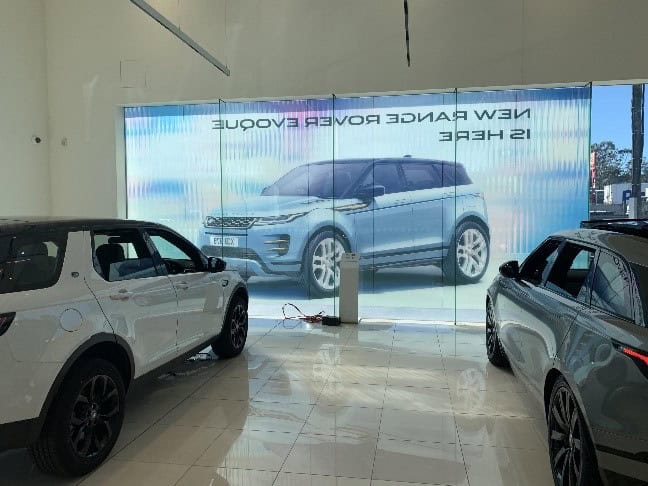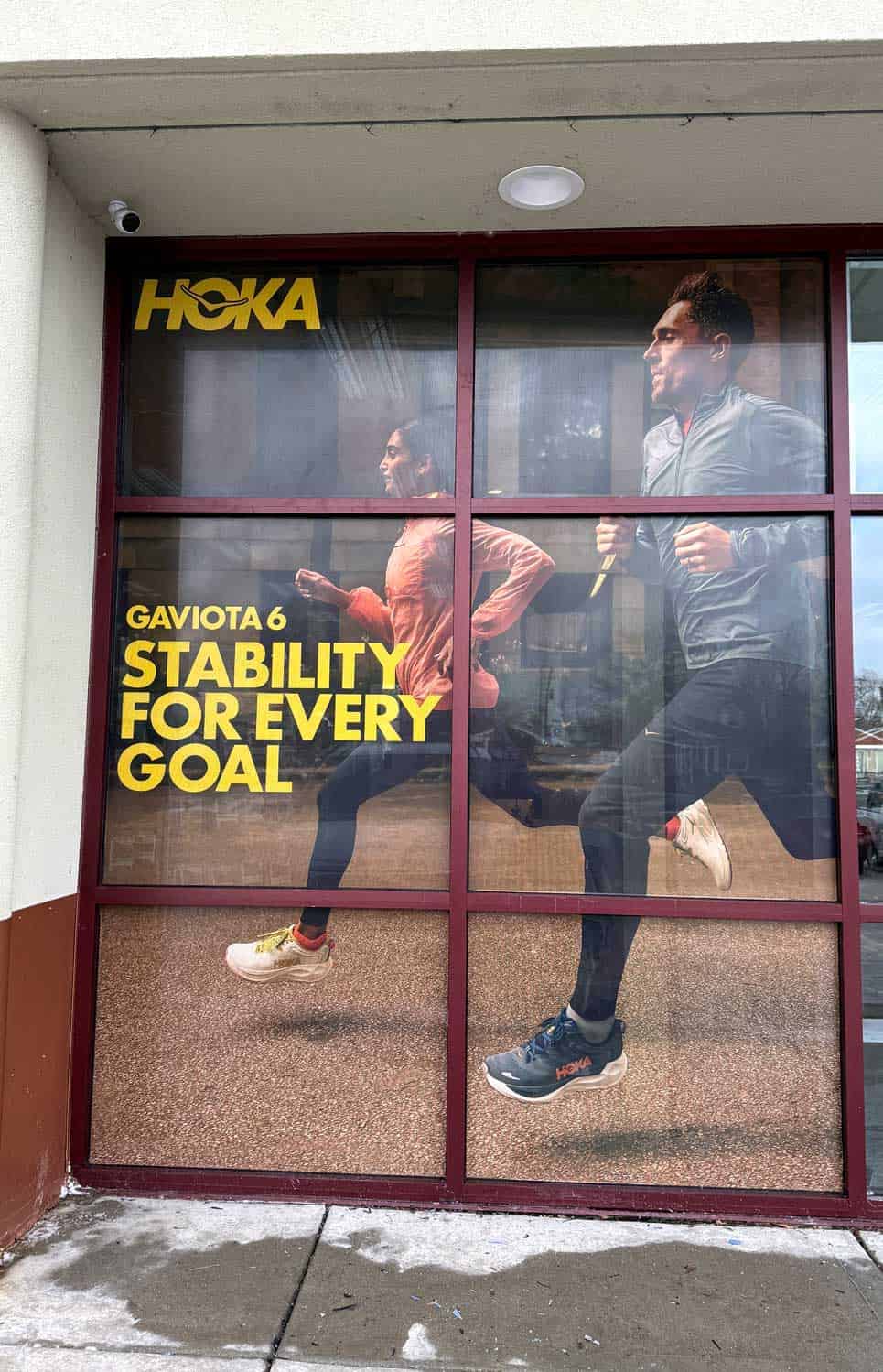
Perforated window film is a printable graphic media punched with a regular pattern of holes, typically about 1.5mm in diameter, so the printed image reads as a solid graphic from outside while people inside still see through the open area. Specifying it well comes down to four decisions made before the roll is ever loaded: perf ratio, mount side, film construction, and the removal window you are promising the end client. Get those four right and the graphic holds for its full term. Get one wrong and somebody is back on a lift in six months, scraping adhesive off a landlord’s glass.
That is the part most spec sheets skip. This guide covers the decisions, the rules that constrain them, and the trade-offs that only show up after installation.
Key Takeaways
- Perf ratio is a trade, not a preference. 80/20 maximizes graphic punch, 50/50 maximizes see-through. The film percentage comes first in the ratio.
- Mount side sets the rest of the spec. Interior mount lets the glass protect the graphic and usually removes the need for lamination. Exterior mount buys color saturation and reach, and it takes on the weather.
- Film construction sets the ceiling on durability. Calendered vinyl for short and medium campaigns, PET for PVC-free and dimensional stability, cast for curved glass and multi-year exterior life.
- Vehicles have a legal line. Federal glazing rules impose a 70 percent light transmittance requirement on glazing in areas requisite for driving visibility, which rules perf out of those locations.
- Removability is a spec line, not a hope. Clean removal up to six months without residue is a stated performance figure, and it is the one the end client remembers.
What perforated window film is, and why one-way vision works
Perforated window film creates one-way vision through a light and contrast imbalance, not through any special optical layer. The outside face carries the print. The back face is usually black, which absorbs light that would otherwise bounce back through the holes and wash out the image. Because the exterior is brighter than the interior during daylight, the eye outside locks onto the bright printed surface and reads the holes as part of the image. From inside, the eye is adapted to lower light and reads through the same holes to the scene outside.
That mechanism has a hard limitation worth naming up front. The effect depends on the light ratio, so it reverses after dark. When interior lights come on and outside goes dark, a perforated graphic loses its punch from the street and the interior becomes more visible. This is not a defect. It is physics, and it is the single most common source of a disappointed retail client.
If the campaign runs into evening hours and night visibility matters, perf is the wrong media. A translucent film such as panoRama TwoWay Vision is engineered to transmit ambient interior light so the graphic stays vibrant after sunset, without printing white ink. Deciding this at quote time is far cheaper than discovering it at the first evening walk-through.
Which perf ratio should you specify?
The first number in a perf ratio is the printable film area and the second is the open hole area, so 80/20 is 80 percent film and 20 percent open. More film means a denser, more saturated graphic. More open area means more daylight and better see-through for the people inside.
| Perf ratio | Film / open | Best for | Trade-off |
|---|---|---|---|
| 80/20 | 80% film, 20% open | Maximum graphic impact, brand walls, daytime privacy | Least see-through, least natural light |
| 70/30 | 70% film, 30% open | Balanced retail storefronts, transit exteriors | Slightly softer color density |
| 60/40 | 60% film, 40% open | Occupied offices, classrooms, long dwell interiors | Graphic reads lighter at distance |
| 50/50 | 50% film, 50% open | Maximum interior visibility and daylight | Weakest graphic punch, holes more visible up close |
Continental Grafix USA supplies 80/20, 70/30, 60/40 and 50/50 across the panoRama line, including panoRama One for short-term campaigns and panoRama Innova for medium-term exterior work. The practical rule from years of field jobs: pick the ratio from the interior occupant’s needs, then design the artwork to survive that ratio. A photographic image with fine detail at 50/50 will look broken. Bold type and flat color at 50/50 look fine.
For a deeper breakdown of how ratio choice affects viewing distance and print detail, see our guide on choosing the right perf ratio for window film advertising.
Interior mount or exterior mount?
Mount side is the decision that quietly determines lamination, print method, durability rating and install cost, so make it before anything else. Exterior mount puts the printed face outward. It delivers the strongest color and works on any accessible glass, and it carries the full load of UV, rain, road grime and vandalism. That is why exterior perf is usually laminated with a product such as panoRama Protect or panoRama Cast Laminate unless the base film is cast.
Interior mount reverses the geometry. The graphic goes on the inside surface and the glass itself becomes the protective layer, which is why interior mount films generally need no overlaminate at all. panoRama Clear is a self-adhesive interior mount perf built for exactly this case, available in 80/20 and 70/30. Note the print requirement that catches people out: because the graphic is viewed through glass from the printed side, interior mount perf is typically printed digitally with white ink.
There is a third path that avoids adhesive entirely. panoRama Film8020 is a PVC-free, non-adhesive 80/20 perf that installs on the interior with panoRama Tape, which stays repositionable during installation. Because it is a PET film with no adhesive, the same roll doubles as an air-permeable hanging banner or room divider, and it is recyclable at the end of the campaign. For leased retail space where the landlord will not permit adhesive on the glass, or for a crew without a trained installer, that combination solves a real constraint.
Interior mount also sidesteps access cost. On an overhead walkway or a second-floor storefront, exterior mount means a lift, a permit and a weather window. Interior mount means a ladder.
Cast, calendered, or PET: matching construction to the promise
Film construction, not perf ratio, sets the ceiling on how long a graphic survives outdoors. Calendered vinyl is the economical workhorse for flat glass and shorter terms. Cast vinyl is dimensionally stable and conformable, which is what curved glass demands. PET is the PVC-free route and holds its dimensions well.
Here is how that maps to real durability ratings under North American Midwest vertical exposure:
| Film | Construction | Exterior durability | Notable spec |
|---|---|---|---|
| panoRama One | Self-adhesive, exterior mount | Up to 2 years | Universal liner for all print methods; four perf ratios |
| panoRama Innova | Self-adhesive, exterior mount | Up to 3 years | Up to 5 years interior; four perf ratios |
| panoRama Green | PVC-free PET | Up to 5 years | 60/40 ratio; ASTM E84 tested |
| panoRama Cast 1530C, 1540C | Premium cast | Up to 7 years | Performs without lamination; conforms to curved glass |
The cast option changes the economics more than people expect. Because panoRama Cast 1530C and 1540C reach long-term exterior performance without an overlaminate, a spec that would have been film plus laminate becomes a single pass. That removes a material line, a lamination step and a production day. On transit vehicle windows and complex architectural glass, where conformability is not optional, it is often the only construction that works.
Where perforated film is legal on vehicles, and where it is not
Federal Motor Vehicle Safety Standard No. 205 imposes a 70 percent luminous transmittance requirement on glazing installed in areas requisite for driving visibility, which is a threshold no perforated film can meet. The requirement comes from ANSI/SAE Z26.1 paragraph S5.2, incorporated by reference into FMVSS No. 205, and it is documented in NHTSA’s Federal Register rulemaking on glazing materials.
Two details in that rulemaking decide most vehicle perf jobs:
- For passenger cars, NHTSA’s stated position is that all windows in the passenger compartment are requisite for driving visibility. That effectively closes the door on perf across a car’s glazing.
- For trucks, buses and multipurpose passenger vehicles, where other means are provided to afford rearward visibility of the roadway, glazing to the rear is excluded from the light transmittance test.
That exclusion is why transit buses, box trucks and fleet vehicles with mirrors are the natural home for vehicle window perf, and passenger cars are not. State and local vehicle codes add their own rules on top of the federal floor, so confirm the jurisdiction before you commit to a fleet rollout.
The demand is real. Out of home advertising revenue reached a record $9.46 billion in 2025, up 3.6 percent year over year and extending the industry’s run to 19 consecutive quarters of growth, with transit the fastest-growing segment at 9.2 percent annually, according to the Out of Home Advertising Association of America. Transit glass is a growing surface, and cast perf is what holds on its curves. Our transit window film solutions page covers that application in detail.
When perforated film replaces window tint
Windows are responsible for about 10 percent of energy use in buildings and influence end uses that comprise 40 percent of building energy use, according to the U.S. Department of Energy’s Building Technologies Office. That is the opening for perforated film as a daytime privacy and solar management product rather than an advertising one.
The context sharpens the case. Space heating accounted for about 32 percent of energy use across all U.S. commercial buildings in 2018, with ventilation and lighting each around 10 percent, per the EIA’s Commercial Buildings Energy Consumption Survey. Glazing sits in the middle of that load.
panoRama Eclipse is built for this use. It is black on both faces with a clear adhesive, in an 80/20 ratio, and it mounts either interior or exterior. The black back limits direct visibility into the space during daylight while occupants keep outward views and natural light. Schools and public buildings, conference rooms, RV and bus windows all fall into this category, and Eclipse also serves as an alternative to step and repeat banners at events held in glass-lined spaces. It prints with white ink on common digital methods.
The distinction to hold onto: perforated film manages daytime privacy and shading, it does not perform like a spectrally selective solar control tint. Spec it for the privacy and branding outcome, and be precise with the client about what it does not do.
Interior perf and fire code
Interior wall and ceiling finish materials are classified by ASTM E84 into Class A (flame spread index 0 to 25), Class B (26 to 75) and Class C (76 to 200), all with a smoke-developed index of 0 to 450, as codified in the model fire and building codes. Both numbers have to land inside the class. A material does not pass on flame spread alone.
For interior mount window perf this matters more than it does for exterior work, because occupancies such as exit corridors, stairwells and healthcare spaces carry the strictest interior finish requirements. Ask for the test documentation during specification, not during inspection. Continental Grafix USA publishes fire certification ratings on the product pages for its perforated lines, and panoRama Green carries ASTM E84 documentation.
Removability belongs in the spec
Clean removal up to six months without residue is a stated performance figure across the panoRama self-adhesive perf line, and it is the number that determines whether you get the next job. Adhesives continue to build tack over time. A film that lifts cleanly at month five can require heat, solvent and hours of labor at month eighteen, and the cost of that difference lands on whoever installed it.
Two practical consequences:
- Quote removal as part of the campaign, not as a favor. If the graphic is coming off in twelve months, price the removal into the original job.
- Match the film’s removal rating to the promised term. A two-year exterior film is not a five-year film with optimism applied. Long-term panoRama Green and panoRama Cast are engineered for clean removal after extended installations; short-term films are not.
We cover the failure modes in more depth in why the real test of a window graphic happens at removal, and the installation side in our tips for installing perforated window film.
Dimensional stability is the quiet partner to removability. A film that shrinks in service pulls away from the edges, opens gaps and leaves adhesive behind in strips. It is why the PET-based and cast constructions carry a durability advantage that shows up at teardown, not on day one.
The spec checklist to run on the next quote
Work these in order. Each answer constrains the next.
- Who is inside, and what do they need to see? This sets the perf ratio before anything aesthetic does.
- Does the campaign run after dark? If night visibility matters, move to a translucent film instead of perf.
- Interior or exterior mount? Check landlord restrictions, access cost, weather window and whether white ink is available.
- How long is the term, and is the glass flat or curved? Term plus curvature selects the construction: calendered, PET, or cast.
- Is this vehicle glazing? Confirm the window is not requisite for driving visibility, then check state code.
- Is it an interior occupancy with a finish classification? Pull the ASTM E84 documentation now.
- Who removes it, and when? Match the removal rating to the term and price the removal into the quote.
Continental Grafix USA has manufactured self-adhesive and non-adhesive perforated window films since 2005 from Statesville, North Carolina, across price points and durability ratings. If a spec sits between two products, request a hand sample and test it on the actual glass before the roll is committed.
Frequently Asked Questions
What is the difference between 80/20 and 60/40 perforated window film?
The first number is the printable film area and the second is the open hole area. An 80/20 film is 80 percent film and 20 percent holes, which produces the boldest graphic and the least see-through. A 60/40 film is 60 percent film and 40 percent holes, which gives occupants noticeably more daylight and outward visibility at the cost of graphic density. Choose 80/20 for advertising impact and daytime privacy, 60/40 for occupied spaces where people spend hours behind the glass.
Can perforated window film be applied to the inside of a window?
Yes. Interior mount perforated film such as panoRama Clear is designed for it, and the glass then protects the graphic from weather, dirt and vandalism, which usually removes the need for an overlaminate. Interior mount perf is typically printed with white ink because it is viewed through the glass from the printed side. Non-adhesive options like panoRama Film8020 install with repositionable panoRama Tape, which suits leased space where adhesive on the glass is not permitted.
How long does perforated window film last outdoors?
It depends on construction, not on the perf ratio. Under North American Midwest vertical exposure, a short-term self-adhesive film such as panoRama One is rated up to 2 years exterior, panoRama Innova up to 3 years, PVC-free panoRama Green up to 5 years, and premium cast panoRama Cast 1530C and 1540C up to 7 years without lamination. Laminating a shorter-term film with panoRama Protect or panoRama Cast Laminate adds protection against UV, moisture and wear.
Is perforated window film legal on car windows?
Not on glazing in areas requisite for driving visibility. FMVSS No. 205 carries a 70 percent luminous transmittance requirement for those locations, and NHTSA’s position is that for passenger cars all windows in the passenger compartment fall into that category. For trucks, buses and multipurpose passenger vehicles, where other means provide rearward visibility of the roadway, glazing to the rear is excluded from that test, which is why transit and fleet rear windows are the common application. State and local codes apply on top of the federal requirement.
Does perforated window film work at night?
Not in the same way. One-way vision depends on the exterior being brighter than the interior, so the effect weakens and reverses once interior lights are on and it is dark outside. The graphic loses impact from the street and the interior becomes more visible. If the campaign needs to perform after dark, specify a translucent film such as panoRama TwoWay Vision, which transmits interior ambient light to keep the graphic readable day and night.
Is there a PVC-free perforated window film?
Yes. panoRama Green is a PVC-free perforated window film built on a polyester (PET) base, available in a 60/40 perf ratio and rated up to 5 years exterior and 7 years interior, with ASTM E84 documentation available. panoRama Film8020 is a PVC-free, non-adhesive PET perf for interior mount work and is recyclable at the end of the campaign. Both integrate into standard solvent, eco-solvent, UV and latex print workflows.
Sources
- Out of Home Advertising Association of America, Out of Home Advertising Revenue Reaches Record $9.46 Billion, March 2026.
- U.S. Department of Energy, Building Technologies Office, Windows.
- U.S. Energy Information Administration, Use of energy in commercial buildings, 2018 CBECS.
- NHTSA, Federal Motor Vehicle Safety Standards; Glazing Materials, Federal Register, June 21, 2012.
- Model fire and building code, Interior Wall and Ceiling Finish and Trim, ASTM E84 classification.
Product specifications and durability ratings are drawn from Continental Grafix USA published product data. Explore the full range on our commercial window films page.
Related News
Today’s In-Plant Print Shops
A Guide to Exterior Graphic Media for Walls, Sidewalks, and Building Entrances
Get Professional-Looking Retail Graphics Without Professional Installers